How to Say I Feel Love Again in Chinese
The fifteen Most Common Ways to Say Good day in Chinese

Maybe y'all already know how to say "hello" in Chinese just you don't know how to say "good day" in Chinese yet.
Or you already know the virtually mutual and simple way to say "goodbye" in Mandarin – 再见 (zàijiàn), but you desire to learn other ways to say "cheerio" in Chinese.
Either way, this commodity will aid you lot understand how native Chinese speakers say "bye". Just have a look at this list of fifteen means to say "goodbye" in Mandarin, and you will soon sound like one of them.
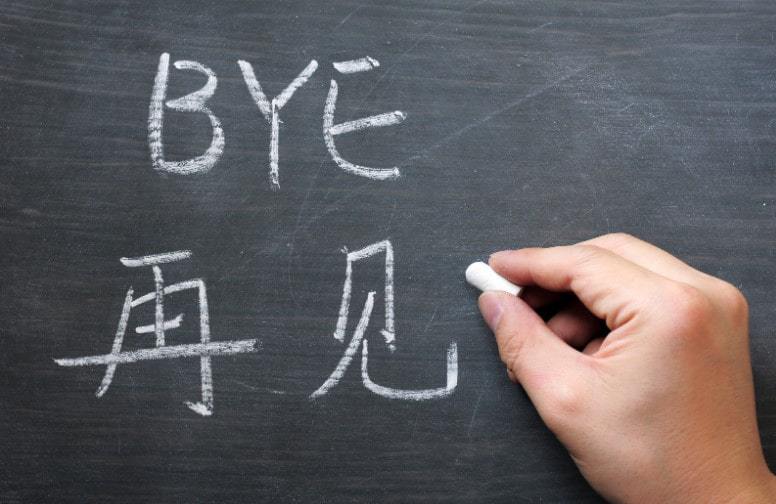
1. "Goodbye" in Chinese – 再见 (zàijiàn)
If you search the internet for "How exercise you say bye in Chinese?", I guarantee that 再见 (zàijiàn) will be the first answer.
But did you know that it's actually closer to "see y'all soon" than "goodbye"?
In Chinese, 再 (zài) ways "again" and 见 (jiàn) is "to see", then when you say information technology, you lot're expecting to see this person once more.
Even though information technology'south not a fault to say it in almost any state of affairs, it won't hurt to larn other ways to say "bye" in Chinese.
2. "Say Goodbye" or "Bid Farewell" in Chinese – 告别 (gàobié)
When yous assume yous won't see a person once again soon and usually when you lot want to be formal too, 告别 (gàobié) is the perfect manner to say "goodbye" in Chinese.
For example, 我是来向你告别的 (wǒ shì lái xiàng nǐ gàobié de, "I came to say goodbye to y'all") is something that yous probably wouldn't say to your friend, simply rather a business organization acquaintance or an older person.
3. "Bye bye" in Chinese – 拜拜 (bàibài)
If y'all've ever met a young Taiwanese person, I'm sure you already know 拜拜 (bàibài) – "bye good day".
It'south not just people from Taiwan who say adieu this way, just it's mostly on this island where you'll hear it at every step.
It's exactly what information technology sounds similar, "bye bye", because it'due south a loanword from English language. You'd be okay to simply say 拜 (bài) but the native Chinese speakers almost always say both of them.
four. "See y'all afterwards" in Chinese – 回头见 (huítóu jiàn)
Some other "goodbye" in Chinese, merely this one actually emphasizes that yous'll see each other later again.
Try to imagine a situation: you and your friend are leaving a classroom or an office meeting, and are you both rushing to continue with your twenty-four hour period. You know that you'll run across each other later, for example at lunch.
It could go like this:
A: 我需要快点去我的办公桌。(Wǒ xūyào kuài diǎn qù wǒ de bàngōng zhuō.) – "I need to bustle up and go to my desk." B: 好吧,我也要快点去。午休见! (Hǎo ba, wǒ yě yào kuài diǎn qù. ǔxiū jiàn.) – "Okay, I also need to go quickly. See you at lunch suspension!" A: 那好吧, 回头见! (Nà hǎo ba, huítóu jiàn!) – "Alright then, encounter you afterwards!"
With this example in mind, it's also easy to remember that Chinese native speakers use the format of "xx 见" (xx jiàn, "xx see") to form the expression: "meet you lot xx (a sure time)".
Y'all'll see what I mean below:
v. "See you tomorrow" in Chinese – 明天见 (míngtiān jiàn)
The perfect example of how "see you xx" is formed in Chinese. Similarly to English, where the "when" is replaced at the terminate, Chinese speakers supervene upon their "when", but at the beginning.
So 明天见 (míngtiān jiàn, "see you lot tomorrow") can be inverse to 星期三见 (xīngqísān jiàn, "see you Wednesday") or, for example, 下周见 (xià zhōu jiàn, "see yous adjacent week") or even 下学期见 (xià xuéqí jiàn, "see you next term").
6. "Encounter you lot before long" in Chinese – 一会儿见 (yīhuì'er jiàn)
While 一 (yī) is "i" in Chinese and 会 (huì) has more meanings, for example, "meeting", "tin" or "be able to", when they're together, they take on a different meaning.
一会儿 (yīhuǐ'er) means "a while", "a moment" or "a scrap" in the context of time.
一会儿见 (yīhuǐ'er jiàn) then means not just "see you lot soon", but as well "encounter you in a bit" or even "bye bye now".

7. "Accept intendance" in Chinese – 照顾自己 (zhàogù zìjǐ)
When saying bye in English language, we sometimes use "take care" and in Chinese this is 照顾自己 (zhàogù zìjǐ).
It'due south common to also go a bit further with your niceness and say 好好照顾自己 (hǎohao zhàogù zìjǐ, "take good care of yourself").
It may be no surprise for you to discover that 照顾 (zhàogù) is not merely used to say "take care" when you're parting means with someone. Similarly to English, it'due south used in contexts of looking subsequently and caring for. When that's the case, 自己 (zìjǐ, "(one)self") is replaced with some other pronoun or a substantive.
Here'due south a couple of examples:
- 她照顾孩子。(Tā zhàogù háizi.) – "She takes care of the children."
- 我病了。请多多照顾。(Wǒ bìngle. Qǐng duōduō zhàogù.) – "I'chiliad sick. Delight, accept care of me."
- 下周请你照顾我的狗吗?(Xià zhōu qǐng nǐ zhàogù wǒ de gǒu ma?) – "Can you please look afterwards my domestic dog next week?"
viii. "Have a dainty 24-hour interval" in Chinese – 祝你今天愉快 (zhù nǐ jīntiān yúkuài)
"Accept a overnice day" is not a common sentence in Chinese. Of course, it makes sense when you lot translate 祝你今天愉快 (zhù nǐ jīntiān yúkuài) discussion by word; if yous did that, it'd expect like this: "wish you lot today happy".
The difference between the English and Chinese version is non only in the way information technology'southward grammatically formed, simply also cultural background.
You lot might recognize 祝 (zhù, "to wish") from sentences like 祝你一路平安 (zhù nǐ yīlù píng'ān, "have a safe journeying") (even though even the 祝 can be omitted).
Just to say "Have a nice day" in Chinese might sound a fleck awkward when translated word by discussion.
Instead, say 玩的开心 (wán de kāixīn, "take fun") or 祝你愉快 (zhù nǐ yúkuài, "I wish you happiness") and y'all'll sound more like a native.
nine. "I'm off" in Chinese – 我走了 (wǒ zǒule)
走 (zǒu) means "walk" or "get" in Chinese. 我走了 (wǒ zǒule) literally means "I walked" or "I went", simply information technology's used as "I'thousand gone" or "I'thousand off" and is most oft in a casual conversation.
Have a expect at some examples of its use:
- 再十分钟,我走了。(Zài shí fēnzhōng, wǒ zǒule.) – "Ten more minutes and and so I'yard gone."
- 好吧,我们完成了,我走了。(Hǎo ba, wǒmen wánchéngle, wǒ zǒule.) – "All right, we're done, I'm off."
10. "I'm leaving" in Chinese – 告辞 (gào cí) or 失陪 (shī péi)
These are very formal ways to say goodbye in Chinese. When you're in a formal, polite setting and you desire to announce your departure, either one is acceptable.
告辞 (gào cí, "farewell") is similar to 告别 (gàobié), while 失陪 (shī péi) means something like "leaving someone's visitor". It's actually used as a whole sentence: "Excuse me, but I must be leaving you lot at present".
11. "Speak to you lot later" in Chinese – 有空再聊 (yǒu kòng zài liáo)
The same fashion in English we say "speak to you lot later", in Chinese it is 有空再聊 (yǒu kòng zài liáo).
Withal, it literallymeans "when y'all're gratuitous, talk again" or "talk once again when you have some time".
Just similar with the English version, this mode of maxim bye in Chinese is by and large common in informal settings, with friends and family.
12. "I look forward to seeing y'all again" in Chinese – 期待见到你 (qídài jiàn dào nǐ)
期待 (qídài) means "look forward to" and also "expect" in some contexts, so this way of saying bye in Chinese is almost the same as it is in English.
见到 (jiàn dào, "to see"). Y'all might recognize 见 (jiàn) from other phrases that you've seen in this article. 到 (dào) is a grammatical complement to express i of the following: "to", "until", result complements, and others. In this example, it but means "until".
Although 见面 (jiànmiàn) ways "to meet", 见到 (jiàn dào) likewise ways "to meet" in sure situations, and then you demand to exist conscientious about the context, equally yous'll see below:
13. "It was prissy seeing you" and "Information technology was nice meeting you" in Chinese – 我很高兴再次见到你 (wǒ hěn gāoxìng zàicì jiàn dào nǐ) and 我很高兴见到了你 (wǒ hěn gāoxìng jiàn dàole nǐ)
You lot might already exist familiar with 认识你我很高兴 (rènshí nǐ wǒ hěn gāoxìng) or 很高兴见到你 (hěn gāoxìng jiàn dào nǐ) – both mean "nice to meet you" or "I'm very happy to meet you". That's because 高兴 (gāoxìng, "happy/glad") is i of the words that yous learn in early on Chinese lessons.
Then to say "it was nice to run into yous" or "it was nice meeting you" will be easy for you to effigy out.
Like I mentioned before, 见到 (jiàn dào) means "to see" or "to encounter" depending on the context. Equally you can see 我很高兴再次见到你 (wǒ hěn gāoxìng zàicì jiàn dào nǐ) contains 再次 (zàicì, "again" or "one time once more"), so you tin can assume that y'all've met this person before, therefore the translation is "it was prissy to run into you (again)".
Whereas 我很高兴见到了你 (wǒ hěn gāoxìng jiàn dàole nǐ) doesn't include whatsoever "again" or "again", so information technology's used when you're speaking to a person that you just met.
fourteen. "Later" or "Take hold of you afterward" in Chinese – 再会 (zài huì)
This expression is similar to 再见 (zàijiàn, "goodbye/cheerio") just non used as often. It'south common to say this one when speaking to a friend or in any casual setting considering it'southward like saying "later" or "take hold of you later" in English.
If you expect closely at each of the characters, you already know that 再 (zài) means "again" and 会 (huì) has many meanings, amongst which "moment" is the one we're looking at in this context.
So together it means "until in a moment" or "until later" = "come across you later/afterwards".
15. "Let's stay in bear upon" – 再联系 (zài lián xì)
"Allow'southward stay in touch" or "keep in affect" ways what information technology sounds similar – "bye" merely "nosotros'll contact each other afterward".
Just here'south the affair – it's probable that you don't really want to contact each other. More likely, you but want to exist polite, simply yous both kind of know that yous won't call the other person.
Let's have a look at an example:
A: 我很高兴见到了你。(Wǒ hěn gāoxìng jiàn dàole nǐ.) – "It was nice to meet you lot." B: 我也很高兴见到了你。再联系! (Wǒ yě hěn gāoxìng jiàn dàole nǐ. Aài liánxì!) – "Likewise/information technology was nice to meet yous, as well. Let's keep in touch!" A: 好吧, 拜拜! (Hǎo ba, bàibài!) – "Alright, bye!"
You kind of need to read between the lines, but by and large, it'south just a polite fashion to say bye in Chinese.

Bye, goodbye, it was overnice to meet you, have fun and have a nice day… Your Chinese farewell vocabulary simply got pretty solid!
Some phrases are different from the ones yous're used to in English and may demand context, but hey, others are very similar — merely wait at 拜拜 (bàibài, "bye goodbye").
Even if you're only starting to learn Chinese and all you know are the bones, beginner Chinese phrases, just recall, it merely takes a scrap of practice to learn it all. And don't forget that the Chinese are generally very polite and kind people, so whichever phrase you apply, the native speaker will still understand you and capeesh yous trying!

Source: https://www.fluentin3months.com/goodbye-in-chinese/
0 Response to "How to Say I Feel Love Again in Chinese"
Post a Comment